Why IQ and EQ aren’t enough
Those two named intelligences each earn their place. IQ — the capacity to analyze, strategize, and solve — is table stakes at the senior level, where virtually everyone in the room has it. EQ — the capacity to understand, manage, and use our emotions, while recognizing and influencing the emotions of others — has, over two decades, rightly become a cornerstone of leadership development.
But neither was designed to address the moment when an external change is calling for an internal identity evolution, not just an operational response.
That is an LTQ gap.
Recognize. Navigate. Act.
Leadership Transition Intelligence is the capacity to see the patterns of identity, relationship, and context that every significant transition reveals — and to transform them on purpose rather than be shaped by them.
It is the inner competence that allows a leader to:
- Recognize when an external change is calling for an internal identity evolution, not just an operational response. To see the transition inside the change before it becomes a crisis.
- Navigate the stages of that internal journey with awareness rather than reaction, so that fear, confusion, and imposter moments become information rather than derailment.
- Act with intention, making deliberate choices about who they are leading themselves to become, rather than defaulting to familiar behaviors that no longer serve the altitude they are at.
It is not about getting smarter, or even more emotionally aware. It is about developing the inner compass that allows you to lead yourself in a direction none of your credentials prepared you to go.
Every transition moves through three stages
Taking-Off
The stage of destabilization and positioning. The ground shifts beneath you and everything feels simultaneously exciting and destabilizing.
How do I prove myself?
Cruising
The stage of competence and the quiet signal. Competence returns, but something quieter starts to pull at you.
Is this still where I want to be?
Awakening
The stage of meaning and reinvention. The questions turn inward, toward meaning, legacy, and what kind of leader you are truly becoming.
Who am I becoming — and is that who I choose to be?
They are not a ladder you climb once. They are an upward spiral: each new role begins a new Taking-Off, at a higher altitude, with more of yourself to bring to it.
The Coherence Triad
A map of the territory is not enough on its own. You also need to understand what gets realigned at every stage, across the three layers of your leadership life.
Me
Your identity, your values, your inner coherence. Who you are becoming when the role, the context, or the challenge changes.
We
Your relationships, your team, the people you lead and are led by. How transitions reshape the trust and connection that make leadership real.
The World
The systems, the context, the expectations, the visibility. How you show up and are seen when everything around you is in motion.
The three layers are not steps. They run at once, and in most leaders they run at different depths. A transition rarely destabilizes all three — it presses hard on one and exposes what the other two have been neglecting.
LTQ is the capacity to read all three layers simultaneously, stay coherent across all three, and make conscious, courageous choices about who you are leading yourself to become.
Nine positions
The Coherence Triad names the three layers. The Coherence Map sets those layers against the three stages of transition, so you can see not only where you are, but what each layer is asking of you at that stage.
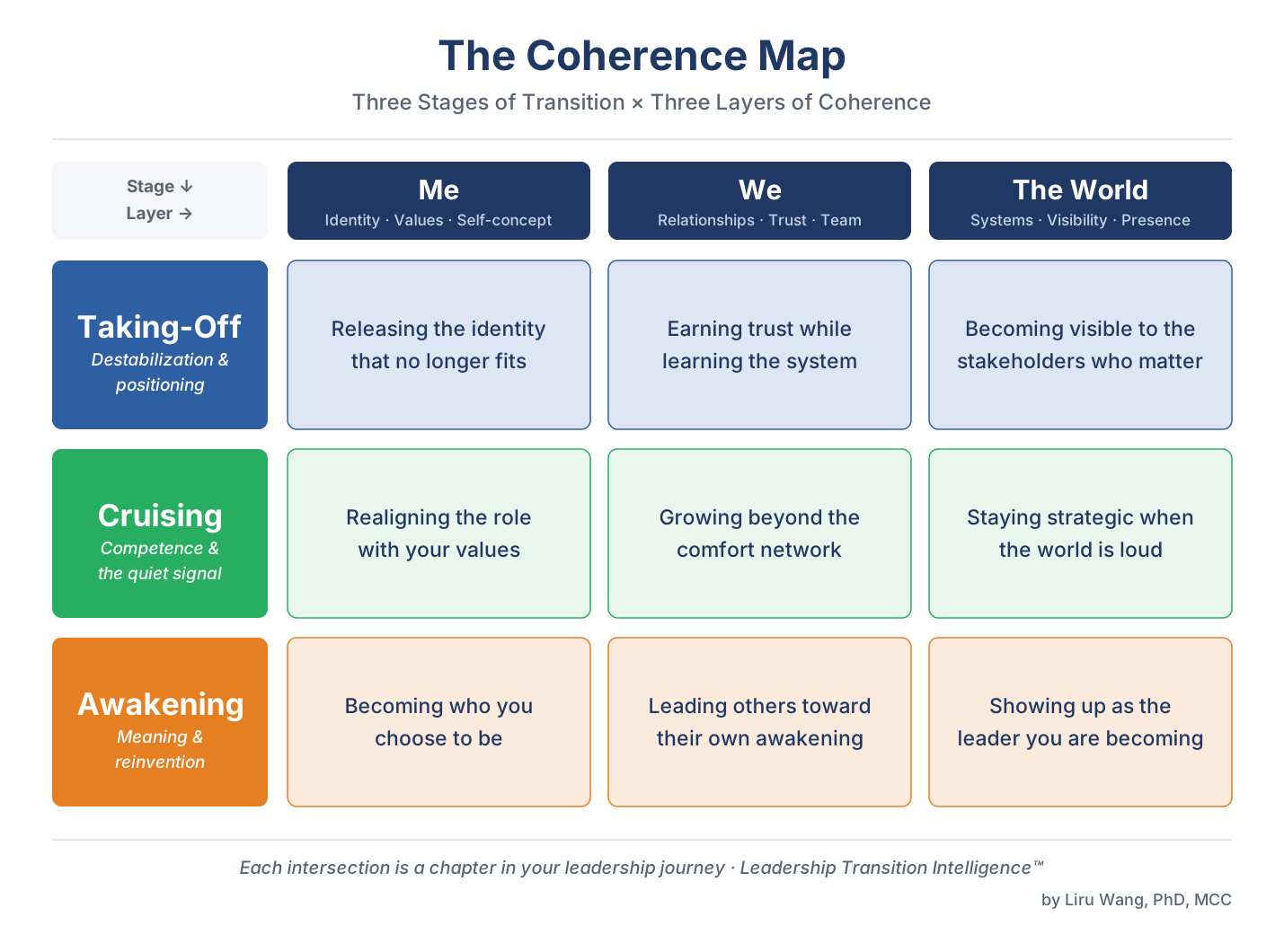
| Me | We | The World | |
|---|---|---|---|
| Taking-Off | Releasing the identity that no longer fits | Earning trust while learning the system | Becoming visible to the stakeholders who matter |
| Cruising | Realigning the role with your values | Growing beyond the comfort network | Staying strategic when the world is loud |
| Awakening | Becoming who you choose to be | Leading others toward their own awakening | Showing up as the leader you are becoming |
Find your stage
The useful question is not whether you have finished the Me layer. It is which layer is carrying more weight than it should — and which one you are avoiding by staying busy in the other two.
The LTQ Self-Assessment is eighteen questions — six per stage, two per layer — and takes about six minutes. You will finish knowing which stage is most active for you, which layer is most activated within it, and what that position is asking of you. It shows where you are now, not what you are capable of — your capacity is what you build next.